It’s well-known that conflict sells. That’s why many commentators focus on keeping the audience perpetually outraged about certain issues; and many newscasters focus on violent crime or car crashes or various other tragedies. But let’s consider something equally important in news coverage: “framing.” It’s a term that comes from photography— deciding not only what’s in the shot but what’s left out. In his 1980 book “The Whole World is Watching,” media theorist Todd Gitlin applied this to news: what we include in our reporting versus what we leave out (for whatever reason), who we cover, who we ignore, who we take seriously, who we trivialize, etc. He discussed how the media establish patterns and interpretations and ways of discussing events, and those interpretations are accepted as the truth (or become the common wisdom), even though certain perspectives may have been omitted.
Gitlin was not accusing reporters of intentionally misleading the public. Rather, he was observing how reporters are shaped by their culture; and without even realizing it, they bring their cultural beliefs into their reporting. For example, the men who reported on the women’s movement of the 1960s were usually traditionalists about gender roles: even the late great Walter Cronkite admitted he did not understand why women were protesting. Given that perspective, the reporting from these men about second-wave feminism was often dismissive, or even mocking. Similarly, given the many reporters who had either covered World War II or served in the military, reporting about the students who protested the Vietnam war was often scornful or negative.
Gitlin also noted that some predictable “media frames” were used when telling certain news stories. One common way to frame a story was to find a conflict: choose a good guy and a bad guy, a hero vs. a villain. Conflict frames are easier to understand, but they run the risk of over-simplifying complex issues. And yet, even today, we see some reporters, and lots of commentators, telling the story with one side being portrayed positively and the other negatively. Again, Gitlin wasn’t asking everyone to say nice things about murderers or to find “the other side” when discussing the Holocaust. He was simply noting that people like to know who they should root for. And by arranging the facts to eliminate any doubt about who the good guy is (or the good country, or the good ideology), reporters (often unwittingly) and commentators (often intentionally) make sure the audience comes away with the “correct” interpretation.
So, forgive the long answer, but it’s a complicated relationship between conflict and journalism. On the one hand, reporters are trained to be accurate and objective, and to report on the day’s most important events fairly; but on the other hand, ratings are always a consideration, and broadcasters need to find stories that will hold the audience’s attention, and they need to present those stories in a way that will resonate with the viewers (or the listeners). Finding a conflict of some kind, finding a story with one side versus the other, has been a popular way to frame certain stories for more than 150 years. And while not all news stories are told that way, we can find many examples of the “conflict frame” in today’s journalism, just like we did in previous generations. MBC
Tag Archives: Peace
What is world War?
A “World War” is a war, usually engaged in by multiple large and small powers, across a large expanse of the earth. The sixteenth century through the early nineteenth century were scatted with them as the new colonial powers fought each other with the various colonies engaged on the world stage.
Most of them were pretty small, but the Napoleonic Wars of the late eighteenth century through the early nineteenth century were much larger. Great Britian came out of the Napoleonic wars as—what we would call today—the world’s strongest “Superpower.” For the next 99 years they exerted control and slammed a lid on any minor wars that might have triggered a World War to ensure a long-term peace known as “Pax Britannica.”
When enough large powers grew up to challenge them in the early twentieth century that “peace” broke down and deteriorated into a World War—known at the time as “the Great War”—that dwarfed the Napoleonic Wars. At the end of the Great War there were no nations strong enough to impose peace, and the world broke into another World War within twenty years that dwarfed the Great War and changed its name into World War I…the second one being named World War II.
At the end of WW II there were two powers strong enough to be called “Superpowers”—the USSR and the USA. Unfortunately, the USSR wanted to use it position to expand control over its neighbors. The US opposed them with a policy known as “containment.” Neither power was really strong enough to overwhelm the other power, and the world settled into another extended period of relative peace known as “Pax Americana” were the two sides engaged in a power struggle using proxies instead of face-to-face confrontations.
The Soviet-American confrontation lasted forty-five years and the Pax Americana has lasted almost seventy-five years at this point but is showing signs of strain. MBC

How would you define war?

A state of beligerance between two nations, or a metaphor for a concerted effort to fight a national threat.
We can talk about war between nations. War between city-states. War between Homo Erectus (humans) and Neanderthals. All of these involve arms and more than one person fighting.
We can also use it as a metaphor, as in the War on Drugs. Or a war on truth. Or a war on the dollar. These lack the usual parts that Von Klauswitz made in his observation that war is diplomacy by other means.
To get a conventional war to end, diplomacy must resume. And war becomes a possibility when diplomacy breaks down.
But if you want to mobilize America to fight drugs, you call it a war on drugs. It allows you to use Navy and Air Force resources to interdict drug transportation. It is not a real war because you cannot negotiate with drug dealers. Some would also say the war on terror is similar.
MBC Mudasir Bedar Chandio the writer and researcher.
Palestine’s Israel matter.

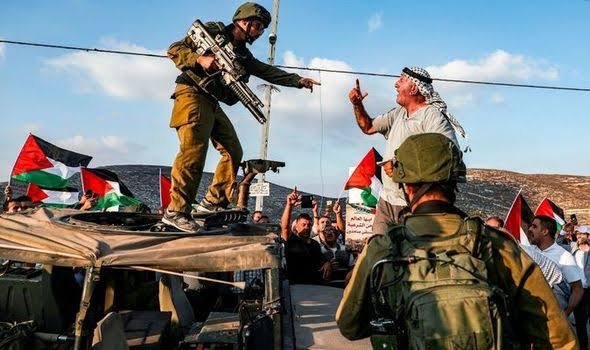
Palestine is a small region of land that has played a prominent role in the ancient and modern history of the Middle East. The history of Palestine has been marked by frequent political conflict and violent land seizures because of its importance to several major world religions, and because Palestine sits at a valuable geographic crossroads between Africa and Asia. Today, Arab people who call this territory home are known as Palestinians, and the people of Palestine have a strong desire to create a free and independent state in this contested region of the world. The word Palestine derives from the Greek word, Philistia, which dates to Ancient Greek writers’ descriptions of the region in the 12th century B.C. Since the fall of the Ottoman Empire in World War I to 1948, Palestine typically referred to the geographic region located between the Mediterranean Sea and the Jordan River. Arab people who call this territory home have been known as Palestinians since the early 20th century. Much of this land is now considered present-day Israel. Today, Palestine theoretically includes the West Bank (a territory that sits between modern-day Israel and Jordan) and the Gaza Strip (which borders modern-day Israel and Egypt). However, control over this region is a complex and evolving situation. There is no international consensus concerning the borders, and many areas claimed by Palestinians have been occupied by Israelis for years. Scholars believe the name “Palestine” originally comes from the word “Philistia,” which refers to the Philistines who occupied part of the region in the 12th century B.C. Throughout history, Palestine has been ruled by numerous groups, including the Assyrians, Babylonians, Persians, Greeks, Romans, Arabs, Fatimids, Seljuk Turks, Crusaders, Egyptians and Mamelukes. From about 1517 to 1917, the Ottoman Empire ruled much of the region. When World War I ended in 1918, the British took control of Palestine. The League of Nations issued a British mandate for Palestine—a document that gave Britain administrative control over the region, and included provisions for establishing a Jewish national homeland in Palestine—which went into effect in 1923. The Partition of Palestine In 1947, after more than two decades of British rule, the United Nations proposed a plan to partition Palestine into two sections: an independent Jewish state and an independent Arab state. The city of Jerusalem, which was claimed as a capital by both Jews and Palestinian Arabs, was to be an international territory with a special status. Jewish leaders accepted the plan, but many Palestinian Arabs—some of whom had been actively fighting British and Jewish interests in the region since the 1920s—vehemently opposed it. Arab groups argued that they represented the majority of the population in certain regions and should be granted more territory. They began to form volunteer armies throughout Palestine. In May 1948, less than a year after the Partition Plan for Palestine was introduced, Britain withdrew from Palestine and Israel declared itself an independent state, implying a willingness to implement the Partition Plan. Almost immediately, neighboring Arab armies moved in to prevent the establishment of the Israeli state. The 1948 Arab-Israeli War that ensued involved Israel and five Arab nations—Jordan, Iraq, Syria, Egypt and Lebanon. By the war’s end in July 1949, Israel controlled more than two-thirds of the former British Mandate, while Jordan took control of the West Bank, Egypt and the Gaza Strip. In the wake of the April air battle, the Soviet Union provided Egypt with intelligence that Israel was moving troops to its northern border with Syria in preparation for a full-scale invasion. The information was inaccurate, but it nevertheless stirred Egyptian President Gamal Abdel Nasser to advance forces into the Sinai Peninsula, where they expelled a United Nations peacekeeping force that had been guarding the border with Israel for over a decade. Israel Defense Forces then launched a preemptive aerial attack against Egypt on June 5, 1967. Both nations claimed that they were acting in self-defense in the ensuing conflict, which ended on June 10 and also drew in Jordan and Syria, who sided with Egypt. The Six-Day War, as it came to be called, resulted in major land gains for Israel.
About the author: Researcher, writer, columist, graduate from media and communication department University of Sindh Jamshoro.
 mbcworld