A state of beligerance between two nations, or a metaphor for a concerted effort to fight a national threat.
We can talk about war between nations. War between city-states. War between Homo Erectus (humans) and Neanderthals. All of these involve arms and more than one person fighting.
We can also use it as a metaphor, as in the War on Drugs. Or a war on truth. Or a war on the dollar. These lack the usual parts that Von Klauswitz made in his observation that war is diplomacy by other means.
To get a conventional war to end, diplomacy must resume. And war becomes a possibility when diplomacy breaks down.
But if you want to mobilize America to fight drugs, you call it a war on drugs. It allows you to use Navy and Air Force resources to interdict drug transportation. It is not a real war because you cannot negotiate with drug dealers. Some would also say the war on terror is similar.
MBC Mudasir Bedar Chandio the writer and researcher.
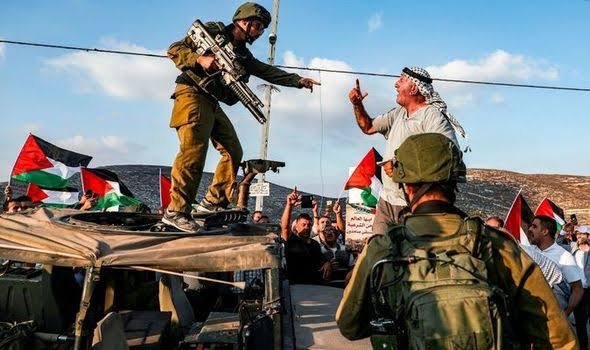
Palestine is a small region of land that has played a prominent role in the ancient and modern history of the Middle East. The history of Palestine has been marked by frequent political conflict and violent land seizures because of its importance to several major world religions, and because Palestine sits at a valuable geographic crossroads between Africa and Asia. Today, Arab people who call this territory home are known as Palestinians, and the people of Palestine have a strong desire to create a free and independent state in this contested region of the world. The word Palestine derives from the Greek word, Philistia, which dates to Ancient Greek writers’ descriptions of the region in the 12th century B.C. Since the fall of the Ottoman Empire in World War I to 1948, Palestine typically referred to the geographic region located between the Mediterranean Sea and the Jordan River. Arab people who call this territory home have been known as Palestinians since the early 20th century. Much of this land is now considered present-day Israel. Today, Palestine theoretically includes the West Bank (a territory that sits between modern-day Israel and Jordan) and the Gaza Strip (which borders modern-day Israel and Egypt). However, control over this region is a complex and evolving situation. There is no international consensus concerning the borders, and many areas claimed by Palestinians have been occupied by Israelis for years. Scholars believe the name “Palestine” originally comes from the word “Philistia,” which refers to the Philistines who occupied part of the region in the 12th century B.C. Throughout history, Palestine has been ruled by numerous groups, including the Assyrians, Babylonians, Persians, Greeks, Romans, Arabs, Fatimids, Seljuk Turks, Crusaders, Egyptians and Mamelukes. From about 1517 to 1917, the Ottoman Empire ruled much of the region. When World War I ended in 1918, the British took control of Palestine. The League of Nations issued a British mandate for Palestine—a document that gave Britain administrative control over the region, and included provisions for establishing a Jewish national homeland in Palestine—which went into effect in 1923. The Partition of Palestine In 1947, after more than two decades of British rule, the United Nations proposed a plan to partition Palestine into two sections: an independent Jewish state and an independent Arab state. The city of Jerusalem, which was claimed as a capital by both Jews and Palestinian Arabs, was to be an international territory with a special status. Jewish leaders accepted the plan, but many Palestinian Arabs—some of whom had been actively fighting British and Jewish interests in the region since the 1920s—vehemently opposed it. Arab groups argued that they represented the majority of the population in certain regions and should be granted more territory. They began to form volunteer armies throughout Palestine. In May 1948, less than a year after the Partition Plan for Palestine was introduced, Britain withdrew from Palestine and Israel declared itself an independent state, implying a willingness to implement the Partition Plan. Almost immediately, neighboring Arab armies moved in to prevent the establishment of the Israeli state. The 1948 Arab-Israeli War that ensued involved Israel and five Arab nations—Jordan, Iraq, Syria, Egypt and Lebanon. By the war’s end in July 1949, Israel controlled more than two-thirds of the former British Mandate, while Jordan took control of the West Bank, Egypt and the Gaza Strip. In the wake of the April air battle, the Soviet Union provided Egypt with intelligence that Israel was moving troops to its northern border with Syria in preparation for a full-scale invasion. The information was inaccurate, but it nevertheless stirred Egyptian President Gamal Abdel Nasser to advance forces into the Sinai Peninsula, where they expelled a United Nations peacekeeping force that had been guarding the border with Israel for over a decade. Israel Defense Forces then launched a preemptive aerial attack against Egypt on June 5, 1967. Both nations claimed that they were acting in self-defense in the ensuing conflict, which ended on June 10 and also drew in Jordan and Syria, who sided with Egypt. The Six-Day War, as it came to be called, resulted in major land gains for Israel.
About the author: Researcher, writer, columist, graduate from media and communication department University of Sindh Jamshoro.
This is a question journalists and editors have been debating for centuries, and because it’s a difficult question to answer, this one may go a little long. So…depending on what has happened that day, a news story might be about what the powerful and the wealthy are doing. Or it might be about what the leader of the country (or the leader of the government) is doing. It might be about crime, or scandal, or political feuds, or controversial issues. It might be locally-focused, or it might involve the entire country (or some other place in the world). In a typical newscast (or in a typical newspaper), news stories can be about all these things, and more— including sports, entertainment, music, the weather, etc.
A news story is a story that informs the public. It is usually about something interesting and important that is happening currently, and it contains the 5 Ws and an H (who did, what did they do, when did they do it, where did they do it, why did they do it, and how did they do it). So, if it’s a crime story about a robbery at a well-known department store, it would contain those 5Ws and an H, but in telling the story, it might also contain quotes from witnesses or the police— whatever would add to the information. And it would be told conversationally: not like a long list of facts. Also, a news story does not guess or speculate: it tells what is known, as factually as possible.
A typical newscast on radio or TV involves selecting the biggest and most important events and then crafting stories that are concise yet thorough, using sound or images to better explain. A newspaper or magazine story contains more details, but it still needs to be told interestingly. Not all of the day’s events are considered newsworthy: presidents and prime ministers give lots of speeches, but not all of them will be in the newscast (a speech about a major policy change or a response to a crisis might be). Celebrities say and do lots of things, but not all of them are newsworthy. Weather happens, but a tornado might be the lead story, while the fact that it’s going to rain tomorrow will not (unless there has been a drought and the possibility of rain becomes news).
Each day, reporters select the stories they believe are the most important for their audience to know. But they want to tell those stories in a way that holds the public’s attention. Years ago, stories were told in a very formal and serious style. Today, the topics may be serious, but the reporters and anchors tend to be less formal and they focus on making sure the story is understandable. And while there is continues to be a debate over which stories are newsworthy and which ones are not, reporting the news thoroughly, fairly, and factually is a very important activity; and those who do it well will earn the public’s trust.



 mbcworld